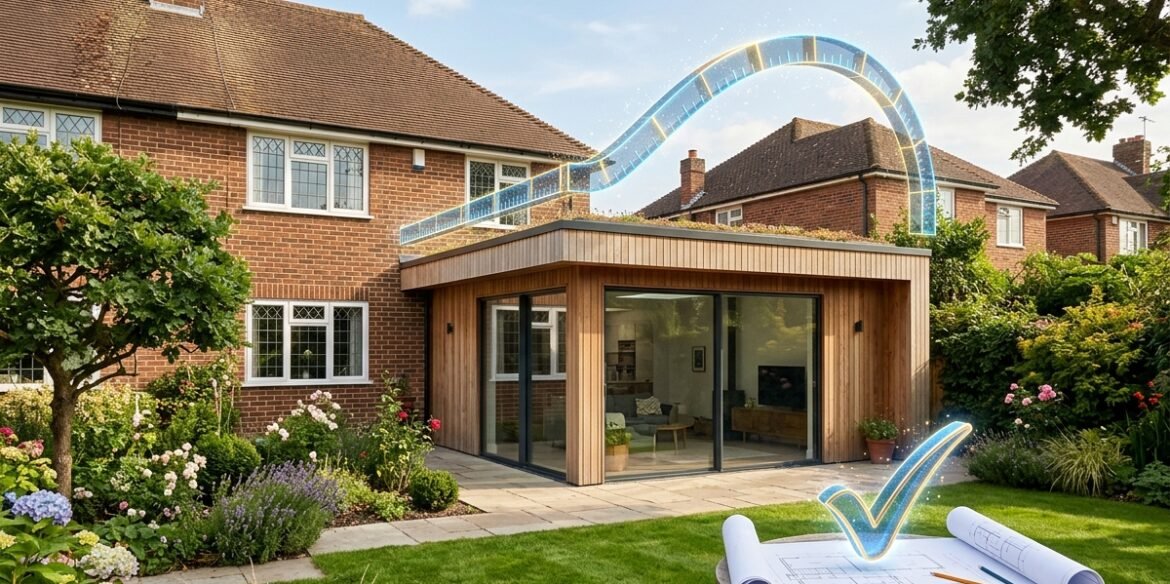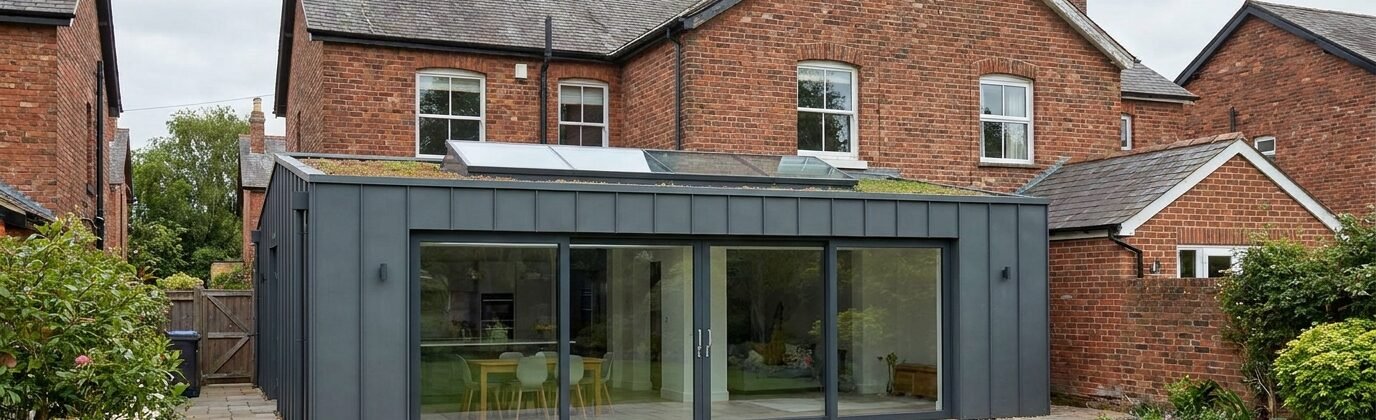
Short answer: probably not. Most rear extensions in England can be built without planning permission, under what’s called permitted development. Long answer: it depends on how big, how tall, where you live, what was built before you owned the place, and a handful of other things that catch people out every single week. This guide walks through every rule that applies to a rear extension in 2026 — written plainly, with the actual measurements, so you can work out within five minutes whether you need to apply for planning permission, prior approval, just a lawful development certificate, or nothing at all.
What is permitted development, in plain English?
Permitted development, often shortened to PD, is a set of rights given to homeowners by national law that lets you carry out certain building work without applying for planning permission. The idea is to spare you (and your council) the time and cost of a formal application for the kind of project most people would say yes to anyway — modest extensions, dormer loft conversions, garden outbuildings, that kind of thing.
Crucially, permitted development is a national right, not a local one. Wandsworth Council can’t refuse a PD extension because they personally dislike flat roofs. As long as you stay within the rules, your project is automatically legal. Around 60 to 70 per cent of UK home extensions in recent years have been built this way.
But — and this is the bit homeowners often miss — ‘within the rules’ is doing a lot of heavy lifting in that sentence. The rules are specific, they compound (more on that later), and they get switched off entirely in certain areas. Get it wrong and the council can serve an enforcement notice years later, even if the work is finished and the kids are grown.
The headline rule: how big can a rear extension be without planning permission?
Here are the actual size limits for a single-storey rear extension in England under permitted development:
| Property type | Standard PD limit | Larger Home Extension limit (with prior approval) |
| Detached house | 4 metres from rear wall | Up to 8 metres |
| Semi-detached house | 3 metres from rear wall | Up to 6 metres |
| Terraced house (mid or end) | 3 metres from rear wall | Up to 6 metres |
If you stay within the standard limit — 4m for a detached, 3m for everything else — you don’t need to tell anyone before you build. You just build. No application, no consultation, no fee.
If you want to go bigger (up to 8m or 6m depending on house type), you’re still under permitted development but you have to go through what’s called the prior approval process. The council notifies your neighbours, they get 21 days to object, and the council either signs it off or refuses. It’s not a full planning application but it’s not nothing either.
The four height rules you can’t ignore
Size projecting from the rear wall is only half the story. There are four separate height limits and your extension has to pass all four:
- Maximum overall height: 4 metres. If your extension is anywhere on the property, it can’t be taller than four metres from ground level.
- Within 2 metres of a boundary: 3 metres. If any part of the extension is closer than two metres to your neighbour’s fence or wall, that part can only be three metres tall. This catches a lot of side-return extensions on terraced houses.
- Eaves height: not higher than the eaves of the original house. Your extension’s eaves can match yours, but not exceed it.
- Ridge height: not higher than the highest part of the existing roof. So if your house has a 7-metre ridge, your extension’s ridge can be up to 7 metres — but it still can’t exceed 4 metres overall, which contradicts that. In practice, single-storey extensions are basically always going to be the 4m limit.
The compounding rule that catches everyone out
Here’s the trap. Permitted development limits aren’t ‘how much can I add today’. They’re ‘how much extension can exist on the property in total, ever, since the house was first built’.
If a previous owner added a 3-metre conservatory ten years ago, you don’t have 3 metres of allowance left and another 3 metres on top. You have zero metres of rear extension allowance under permitted development. The original house, in PD terms, is the house as it stood on 1 July 1948 or the date it was built — whichever is later. Everything added since then counts against your limits.
This applies even if the previous extension had its own planning permission. Permitted development is calculated separately from formal planning consent, and any extension at all, however it was built, eats into your allowance.
The practical implication: before you assume you can extend under PD, check what’s already been added. Old planning records, the property’s title plan, and an honest look at the building (does the kitchen jut out further than the original house?) will tell you. If a previous extension exists, you may need to apply for full planning permission for your new project even if it’s a small one.
The other PD conditions, in one list
Beyond size and height, your extension must also:
- Not cover more than half of the area of land around the original house. Sheds, garages, and earlier extensions all count towards this 50 per cent limit.
- Use materials similar in appearance to the existing house. A glass-and-cedar box on a brick Edwardian terrace isn’t going to qualify.
- Have no verandas, balconies, or raised platforms above 300mm. Roof terraces and Juliet balconies push you out of PD.
- Not include any upper-floor side windows unless they’re obscure-glazed and non-opening below 1.7m above floor level. This is the privacy rule.
- Not extend forward of the front elevation that fronts the highway. Front extensions almost always need planning permission.
- Not be on designated land — and that’s where it really gets specific.
When permitted development doesn’t apply at all
Permitted development rights are removed entirely on certain types of property. If any of these apply to your home, you cannot rely on PD and will almost certainly need a planning application for any rear extension:
Listed buildings
Grade I, II*, and II listed buildings have no permitted development rights for extensions. You’ll need both planning permission and listed building consent — two separate applications, often with extra heritage assessments. Listed building works carried out without consent are a criminal offence, not a civil planning matter, so this is one to take seriously.
Flats and maisonettes
Permitted development rights for extensions apply to houses, not flats. If you own a maisonette or a flat, even a ground-floor one with a garden, you cannot extend under PD. You’ll need full planning permission, and your lease will also need to allow alterations.
Conservation areas, AONBs, and national parks
In these designated areas, side extensions and two-storey rear extensions are entirely outside PD. Single-storey rear extensions are still allowed, but the limits are tighter and the materials rules stricter. There are over 10,000 conservation areas in England — if you live in central London, an old market town, or anywhere with character, check first.
Article 4 directions
Local councils can issue something called an Article 4 direction that removes permitted development rights from a specific area or street. They’re common in central London — large parts of Kensington, Camden, and Westminster have them — and increasingly in conservation pockets elsewhere. The council’s own planning policy maps will show whether your road is affected. If it is, even tiny works that would normally fly under PD will need planning permission.
Even if you don’t need planning permission, get a Lawful Development Certificate
This is the single most important practical tip in this guide, and most homeowners skip it.
Even when your extension genuinely qualifies as permitted development, applying for a Lawful Development Certificate (an LDC, sometimes called a CLPUD for proposed works or CLEUD for existing) gives you a formal council document confirming that. It costs £120, takes about eight weeks, and the council either issues it or tells you why your project doesn’t qualify.
Why bother? Three reasons:
- Selling the house. Conveyancing solicitors will ask for proof that any extension was lawful. Without an LDC, the only proof is ‘trust me’. An LDC removes that problem and can knock weeks off a sale.
- Council enforcement. If a neighbour complains years later, the council can investigate. With an LDC in hand, the matter is closed in five minutes. Without one, you’re proving your case retrospectively, which is harder and more stressful.
- Mortgage and remortgage. Surveyors and lenders sometimes flag unexplained extensions and demand documentation before releasing funds.
Spend the £120, get the certificate. We can’t think of a single client who’s regretted having one. We can name several who wished they’d applied for one when they did the work twenty years ago.
When you definitely need full planning permission
To summarise the negative cases — you’ll need a full planning application for a rear extension if any of the following are true:
- The extension is bigger than the larger home extension allowance (more than 8m for detached, more than 6m for everything else).
- It’s a two-storey rear extension that extends more than 3m from the rear wall.
- The property is listed, a flat, in a conservation area with restrictions, or under an Article 4 direction.
- Earlier extensions already exhaust your PD allowance.
- The proposed materials, balconies, side windows, or roof terraces fall outside PD rules.
- You’re extending forward of the front elevation.
Full planning permission costs £258 to apply for, takes around eight weeks for a decision in straightforward cases (longer if it goes to committee), and the council can refuse. Refusal isn’t the end — you can appeal or resubmit with changes — but it adds months. Working with an architect who knows your local council’s quirks is usually the difference between approval and rejection.
The 4-step check before you commit to a design
Here’s the order we’d suggest you follow before paying anyone to draw plans.
- Step 1: Identify your property type. Detached, semi-detached, terraced, or flat? Is it a listed building? You can check listed status on Historic England’s ‘Search the List’ tool.
- Step 2: Check for designated land or Article 4. Type your postcode into your local council’s planning portal. Look for the words ‘conservation area’, ‘AONB’, and ‘Article 4 direction’ under your property’s details. If you see any of them, PD is off the table for at least some of what you might want.
- Step 3: Audit existing extensions. Walk around the back of your house. Anything that sticks out further than the original walls counts. Old aerial photos (Google Earth’s history slider works well) can also reveal extensions added before you bought the place.
- Step 4: Measure against the limits. With your property type, designated status, and existing extensions known, compare your design’s dimensions to the PD limits above. If you’re inside them, you’re in PD territory — apply for an LDC. If you’re outside, plan a full planning application.
Frequently asked questions
How long does a Lawful Development Certificate take?
Eight weeks is the statutory determination period. Most councils hit it; some run over by a fortnight or so. You can submit drawings and the £120 fee through the Planning Portal yourself, or have an architect handle the full submission.
How long does prior approval take for a larger extension?
42 days, including the 21-day neighbour consultation period. If no neighbour objects on planning grounds, the council usually waves it through. If a neighbour does object, the council has to weigh whether the objection is materially planning-related (loss of light, overshadowing, privacy) — not just personal dislike.
Can I start building before the LDC is approved?
Legally, if your project genuinely is permitted development, you can — PD doesn’t require an LDC to be valid. But we strongly advise waiting for the certificate. If the council later disagrees with your interpretation of the rules, you’re left with an unauthorised extension and far fewer options to fix it.
My neighbour is extending and I think it’s outside PD. What can I do?
Report it to the planning enforcement team at your local council. They’ll investigate and decide whether to take action. The council has four years from completion to act against a breach of permitted development (or in some cases ten years), so you don’t need to be in a rush, but earlier is better.
Does this apply in Scotland, Wales, and Northern Ireland?
No. The rules in this guide are for England. Scotland, Wales, and Northern Ireland each have their own permitted development regimes with different limits and conditions. Always check the rules that apply in your jurisdiction.
The bottom line
For most homeowners in England, a single-storey rear extension up to 3 or 4 metres falls neatly inside permitted development and doesn’t need planning permission. Go bigger and you’ll need prior approval. Go on a listed building, a flat, or designated land and you’ll need full planning. In all cases, get a Lawful Development Certificate after the work — it’s the cheapest insurance policy in the property world.
The bit homeowners get wrong most often isn’t the size or the height — it’s assuming the rules apply in isolation when they actually stack. Existing extensions, your property’s location, your house type, and the design choices all interact. A good architect spots those interactions before they become problems.
Want us to check whether your rear extension qualifies as permitted development?
Send us your address, a quick description of what you’re thinking, and a photo or two of the back of the house. We’ll come back within 24 hours with a clear answer — PD or planning, what the limits are, and what your route looks like. No pressure, no fee for the initial check, and if you do go ahead with us, we handle the drawings, the Lawful Development Certificate or planning application, and everything in between.
Call us on +44 7594 188857 or use the contact form. We work across London, Manchester, Birmingham, and Liverpool.