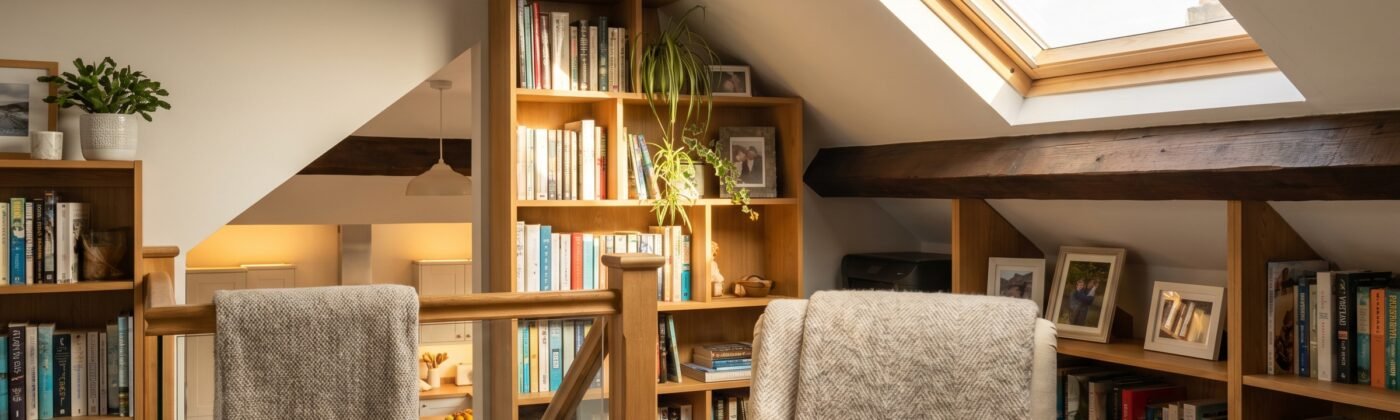
You know that feeling when you’re standing in your hallway, staring up at the ceiling, wondering what on earth is going on in that dusty space above you? We’ve had that conversation with hundreds of homeowners across Manchester, and every single one of them said the same thing: “I had no idea it could be that straightforward.”
And honestly? It can be. But it can also go sideways fast if you don’t understand the rules.
So let’s have a proper, no-jargon conversation about loft conversions in 2026 — what you can do, what you can’t, what it’ll cost you, and how to make sure you don’t spend a single penny before you’ve got your ducks in a row.
Why Loft Conversions Are Everywhere Right Now
There’s a reason your neighbour in Didsbury just got scaffolding up, and the family two doors down in Chorlton are living through weeks of builders. The cost of moving house has become genuinely painful — stamp duty, solicitor fees, estate agent costs, the emotional weight of uprooting your whole life. People are staying put and building up instead.
A well-done loft conversion typically adds between 10 and 20 percent to a property’s value. In Manchester’s current market, that’s not a small number. Add a bedroom and an en-suite above a three-bed semi in Stretford or Sale, and you’ve potentially transformed both your living situation and your investment.
But here’s where it gets interesting — and where people often trip up.
Do You Actually Need Planning Permission? (The Honest Answer)
The short answer is: it depends. And we know that’s frustrating to hear, but stay with us.
Most loft conversions in England fall under something called Permitted Development rights. These are rules set by Parliament that allow you to make certain improvements to your home without going through the full planning permission process. For loft conversions, this typically means:
- Maximum 40 cubic metres of new space for terraced houses
- Maximum 50 cubic metres for detached and semi-detached properties
- Materials must match the existing house in appearance
- No balcony, veranda, or raised platform
- Side-facing windows must be obscure-glazed and non-opening below 1.7m
If your project stays within these limits, you’re in Permitted Development territory. No full planning application needed. But — and this is a big but — Permitted Development does NOT apply to:
- Flats or maisonettes
- Listed buildings
- Properties in conservation areas (where rules are stricter)
- Areas with Article 4 Directions in place
Manchester has quite a few conservation areas — Didsbury Village, Ancoats, Heaton Moor, Victoria Park — so if you’re in one of these, you’ll want to check before assuming you’re covered.
What About Prior Approval?
Here’s something many homeowners don’t know about: the Prior Approval Larger Home Extensions scheme. It’s essentially a middle ground — not full planning permission, but a notification process that lets your council check your extension against specific criteria.
At ARM Design & Build, we handle Prior Approval applications regularly. It’s actually one of our most popular services because it covers rear extensions beyond the standard Permitted Development limits — up to 8 metres deep on a detached house, and 6 metres on a semi-detached or terraced. And unlike a full planning application, it has no application fee. Find out more about our Prior Approval service here.
The Lawful Development Certificate: Why You Probably Want One
Even if your loft conversion falls squarely within Permitted Development, we almost always recommend applying for a Lawful Development Certificate (LDC). Think of it as documented proof that what you’ve built is legal.
Here’s why it matters. When you eventually sell your home, the buyer’s solicitor will ask. Without an LDC, buyers can demand indemnity insurance, reduce their offer, or in some cases, walk away. In Manchester’s competitive property market, the last thing you want is a sale falling through over something completely avoidable.
An LDC costs around £103 to apply for in England (2026 fees), takes approximately 8 weeks, and gives you written confirmation from the council. We handle LDC applications as part of our full planning service.
The Different Types of Loft Conversion — Which One is Right for You?
Not all loft conversions are created equal. The right type for your home depends on your roof structure, the headroom you’ve got, and what you want to use the space for.
- Velux / Rooflight Conversion: The simplest and cheapest option. You’re not changing the roof structure at all — just adding roof windows. Costs typically start around £15,000–£25,000 and almost always fall within Permitted Development. Perfect if you’ve got enough headroom already.
- Dormer Conversion: The most popular type in Manchester and across the UK. A box-like extension projects from the slope of the roof, dramatically increasing headroom and floor space. Rear dormers are almost always Permitted Development; front dormers usually require full planning permission.
- Hip-to-Gable Conversion: Common on detached and semi-detached houses, this changes the sloping side of the roof into a vertical wall. Creates a lot of usable space but almost always requires planning permission.
- Mansard Conversion: The most dramatic option — nearly vertical walls with a flat roof on top. Creates a lot of space but nearly always requires full planning permission. Often seen in London rather than Manchester, though we’ve delivered several of these in Salford and Trafford.
How Much Does a Loft Conversion Cost in Manchester in 2026?
Let’s talk real numbers. This is where people often get surprised, and we’d rather have this conversation with you up front.
A basic velux conversion in Manchester starts from around £15,000–£20,000. A dormer conversion — the most popular choice — typically runs between £35,000 and £65,000, depending on size and specification. Hip-to-gable and mansard conversions can cost £50,000–£80,000 or more.
These figures include structural work, building regulations compliance, and fit-out, but you should also budget for:
- Architect/design fees: typically 8–15% of build cost
- Structural engineer calculations: £500–£2,000
- Building regulations: £600–£1,200
- Party Wall Agreement (if applicable): £700–£1,500 per neighbour
The good news is that Manchester is generally 20–30% cheaper than London for comparable work. And a well-executed loft conversion in a property like a Victorian terrace in Levenshulme or Whalley Range can add significant value — often more than the project costs.
Building Regulations: The Part Nobody Tells You About
Planning permission (or Permitted Development) and building regulations are two completely separate things. You can have one without the other, and you need both.
Building regulations are the safety standards your conversion must meet — things like fire escape routes, structural integrity, insulation values, and stair dimensions. They apply whether your project needs planning permission or not.
Compliance is checked by a Building Control officer, either from your local council or a private Approved Inspector. At ARM Design & Build, we work with both, and we include all drawing submissions, inspection coordination, and compliance documentation within our project management service.
We’ve helped clients across Manchester, London, Birmingham, and Liverpool get their building regulations right first time, every time. See some of our completed projects here.
A Note on Conservation Areas in Manchester
Manchester City Council has over 30 designated conservation areas, and Greater Manchester as a whole has significantly more. If you’re in one — Didsbury, Ancoats, Heaton Chapel, parts of Salford — the planning rules are noticeably stricter.
In a conservation area, Permitted Development rights for roof alterations are often removed or restricted. You may need full planning permission even for a dormer that would be automatic PD elsewhere. The council will want materials and design to be sympathetic to the character of the area.
This isn’t a reason to abandon the project. It’s a reason to get the design right from the start. A well-designed loft conversion in a conservation area can absolutely get approved — but you want experienced architects who understand how to present these applications effectively.
That’s exactly what we do. Book a free consultation with our team.
What’s the Process? What Should I Do First?
Here’s our recommended order of operations for anyone in Manchester thinking about a loft conversion:
- Step 1: Check your permitted development rights — call your local council or speak to an architect
- Step 2: Get a measured survey of your loft space to understand what’s structurally possible
- Step 3: Get concept designs drawn up and decide on the type of conversion
- Step 4: Apply for a Lawful Development Certificate (if PD) or full planning permission
- Step 5: Submit building regulations drawings and appoint a structural engineer
- Step 6: Get quotes from builders and begin construction
- Step 7: Sign off with Building Control and get your completion certificate
ARM Design & Build can manage every single one of those steps for you. We’re an all-in-one architectural and construction practice — which means you’re not juggling five different companies and hoping they talk to each other. Learn more about how we work.
Real Talk: What Can Go Wrong (And How to Avoid It)
We’ve seen it happen more times than we’d like. Someone gets excited, hires a builder before getting planning sorted, starts work, and then gets a letter from the council. Enforcement notices are stressful, expensive, and sometimes result in work being demolished.
The other common mistake: assuming Permitted Development covers everything. It often does — but not always. A neighbour in a different street might have a virtually identical house with different rights because of a local Article 4 Direction they’ve never heard of.
The fix for both is simple: talk to someone who knows what they’re doing before you spend any money on builders. A proper planning consultation at the start costs a fraction of what going wrong costs at the end.
Ready to Talk About Your Loft?
Whether you’re in Manchester, London, Birmingham, or Liverpool — if you’ve got a loft you’ve been staring at and wondering about, we’d love to hear from you.
ARM Design & Build has 15 years of experience turning those unused spaces into beautiful, legal, building-regulations-compliant rooms that add real value to real homes. We’ve done it in Victorian terraces in Levenshulme, Edwardian semis in Sale, and new-builds in Salford Quays.
We’re not just architects. We’re builders too. And we care about the end result as much as you do. Get in touch with us today for a free, no-obligation chat.