The world of construction and renovation is constantly evolving, and in 2026, technology is playing an increasingly crucial role in streamlining projects. One such advancement is the use of 3D laser scanning for measured building surveys, which has revolutionized how we approach renovations in the UK. By translating the real-world measurements of a building into CAD models, professionals can save both time and money, all while ensuring a level of precision that was previously unachievable. In this blog, we’ll explore how 3D laser scanning combined with CAD modeling is changing the landscape of UK renovations and why it’s a must-have tool for property owners in cities like London, Manchester, and Birmingham.
1. What is 3D Laser Scanning and How Does It Work?
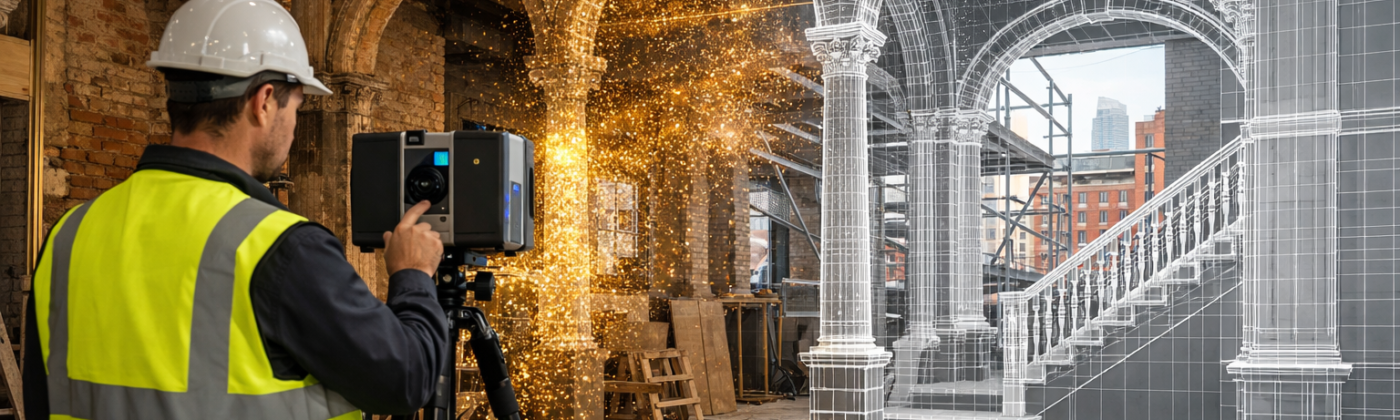
3D Laser Scanning uses laser beams to capture precise measurements of a building’s existing structure, creating a digital point cloud that represents every feature and detail. These measurements are then converted into CAD (Computer-Aided Design) models, which can be used for architectural design, structural planning, and construction.
Why 3D Laser Scanning?
Traditional surveys can be time-consuming and prone to human error. With 3D scanning, surveyors can capture highly accurate data in a fraction of the time. The result is an extremely detailed, scalable, and accurate digital representation of the building, which forms the foundation for all renovation plans. This process eliminates guesswork and allows for smarter decision-making during the design and construction phases.
2. The Traditional Survey vs 3D Laser Scanning: What’s the Difference?
Traditional Surveys
In traditional surveys, measurements are taken manually using tape measures, total stations, and levels. While this method has been the standard for years, it’s time-consuming and often subject to human error. For example, measuring an entire building’s dimensions can take days or even weeks, especially for larger or complex buildings.
3D Laser Scanning Surveys
In contrast, 3D scanning captures millions of data points in a matter of hours, creating a fully detailed 3D model of the building. This method is not only faster but also eliminates common human errors associated with traditional surveys, offering higher accuracy and greater precision for renovation projects.
3. How CAD Models Enhance Renovation Projects
Precision in Design
Once the 3D laser scan is completed, the point cloud data is converted into a CAD model, which architects and designers can use for detailed planning. These CAD models can represent everything from the building’s layout and structural elements to its electrical systems, making them indispensable tools for renovations.
Why CAD Models Are Crucial
- Accuracy: CAD models are far more precise than hand-drawn blueprints and can be easily adjusted as the project evolves.
- Visualization: CAD models allow stakeholders to see what the final renovation will look like before construction begins, helping to avoid surprises and misunderstandings.
- Modifications: If changes need to be made during the renovation, CAD models can be adjusted easily, which saves time compared to reworking traditional plans.
4. How 3D Scanning and CAD Models Save Time and Money
Saving Time
- Faster Data Collection: Traditional surveys can take days or even weeks to complete, but with 3D laser scanning, a detailed survey can be done in a matter of hours. This dramatically speeds up the planning phase of renovations.
- Quick Design Iterations: With the help of CAD, designers can easily create multiple design options and make changes to the model without wasting time on revisions to physical blueprints.
Saving Money
- Reduced Rework: Since 3D laser scanning provides highly accurate data, the need for costly revisions or rework during construction is greatly reduced. Inaccuracies discovered later in the project can lead to significant delays and unexpected costs, which are avoided with 3D scanning.
- Minimized Material Waste: Accurate measurements in CAD models lead to more efficient use of materials, reducing waste and lowering overall project costs.
- Streamlined Decision-Making: With clearer, more precise data, all project stakeholders from architects to contractors can make more informed decisions, which results in faster project completion and fewer costly mistakes.
5. Real-Life Benefits for UK Renovation Projects
In busy urban areas like London, Manchester, and Birmingham, where space is limited and building regulations are strict, 3D scanning and CAD modeling offer even more value. Here’s how they can benefit specific projects:
- Renovations in Heritage Buildings: In cities like Birmingham, where historic buildings are common, 3D scanning is essential for capturing the intricate details of the structure. The data collected can then be used to preserve these features while integrating modern updates without compromising the building’s historical value.
- Extensions in Urban Areas: For extensions in London and Manchester, where there is a need to maximize available space, a CAD model ensures that new construction fits perfectly with the existing building and complies with zoning laws.
- Commercial Renovations: In commercial projects, where the layout and design need to be optimized for functionality, 3D scanning and CAD models help architects design the space efficiently and avoid costly mistakes.
6. How to Get Started with 3D Scanning and CAD Models for Your Renovation
If you’re considering using 3D laser scanning and CAD modeling for your next renovation project, it’s important to work with a professional team who specializes in these technologies. Look for a measured surveyor or a 3D scanning service provider who can handle the entire process from scanning to creating detailed CAD models.
Additionally, many companies now offer complete surveying packages that include everything you need, from initial scans to the final CAD files, which can be directly used in the construction process. This comprehensive service ensures that your renovation project runs smoothly from start to finish.
Conclusion
In 2026, using 3D laser scanning and CAD models for your UK renovation project isn’t just a luxury it’s a necessity. The benefits of accuracy, time efficiency, and cost savings are clear, especially in busy cities like London, Birmingham, and Manchester, where precise measurements and adherence to building codes are critical. By adopting these advanced technologies, property owners can ensure that their renovation projects are completed on time, on budget, and to the highest standards.